China’s position in food machinery is changing quickly, and chocolate equipment now reflects that shift. Oatmeal chocolate products require more than attractive moulds. They demand stable dosing, controlled cooling, accurate vibration, and hygienic contact surfaces. This is where oatmeal chocolate moulding machines become commercially important.
The International Cocoa Organization’s 2023/24 market updates show continuing pressure on cocoa supply and pricing. Manufacturers therefore need efficient systems that reduce waste and protect every gram of chocolate. Meanwhile, PMMI’s recent packaging reports highlight automation, traceability, and flexible production as major investment priorities. These trends matter for oat-based chocolate bars, clusters, and filled snacks. Small errors remain expensive.
Dr. Ewald Notter, a respected chocolatier and author of The Art of the Chocolatier, states, “Consistency is the foundation of professional chocolate work.” That principle fits modern moulding lines precisely. A reliable machine should maintain mould temperature, deposit weight, and release performance across long production runs. It should also handle recipe changes without creating excessive downtime.
Chinese suppliers increasingly combine servo-driven dosing, PLC controls, quick-change mould systems, and stainless-steel frames. These features can support export-oriented factories and private-label production. However, specifications alone do not prove performance. Buyers should request trial results, cleaning procedures, energy data, and after-sales records.
Some suppliers still publish unclear capacity figures. That deserves scrutiny. The best purchasing decision comes from measured output, not impressive photographs. In this guide, we examine how China’s leading oatmeal chocolate moulding machines suppliers compare on engineering quality, customization, compliance support, and practical operating value.
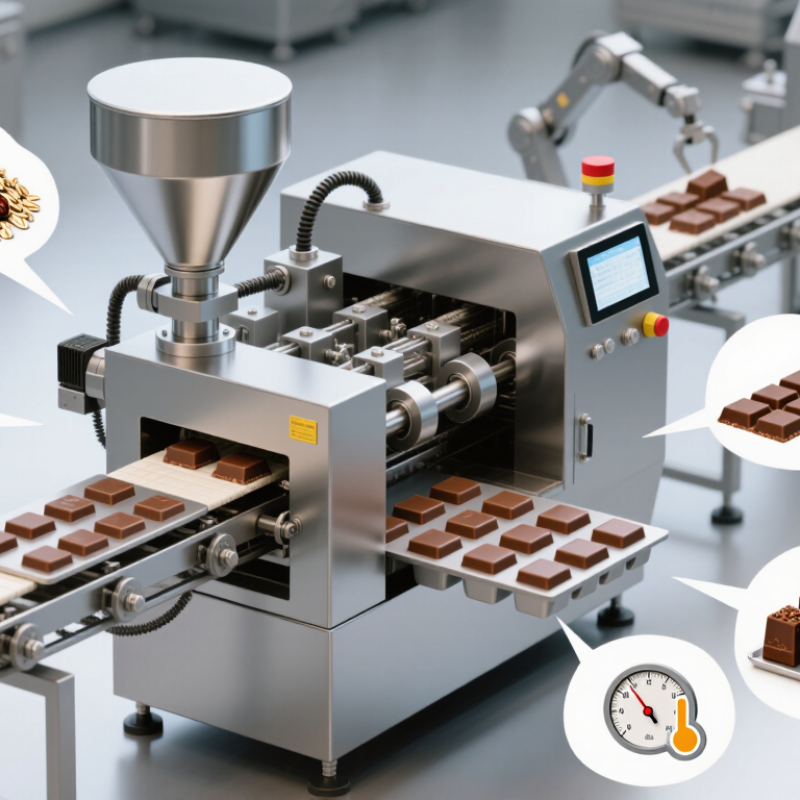
Oatmeal chocolate moulding machines shape chocolate products with controlled portions, temperature, and surface finish. They usually combine a chocolate hopper, dosing unit, mould conveyor, vibration table, and cooling tunnel. The system deposits tempered chocolate into moulds, distributes oatmeal evenly, and removes trapped air. Baked oatmeal should remain dry and crisp. Excess moisture can weaken texture and shorten shelf life. Machine settings depend on chocolate viscosity, oatmeal size, mould depth, and production speed. No single setting suits every recipe.
Tips: Keep oatmeal particles consistent in size. Check chocolate temperature regularly. Clean contact surfaces after each production run. Test a small batch before full operation. This simple step can reveal uneven filling, weak release, or poor texture.
Reliable equipment should offer stable temperature control, accurate dosing, accessible parts, and clear operating records. Operators should inspect mould alignment and cooling performance during every shift. In practice, small variations still appear. Oatmeal may settle unevenly, especially at higher speeds. Reducing conveyor speed can improve distribution, but it may lower output. This trade-off deserves careful testing. Experienced suppliers should explain capacity limits, maintenance needs, and food-contact material requirements without hiding technical details.
Oatmeal chocolate moulding machines are production systems that temper chocolate, combine it with ingredients such as oats, deposit the mixture into moulds, vibrate it for even distribution, and cool it until the finished pieces are solid. The chart shows typical chocolate tempering setpoints used before moulding.
China Top Oatmeal Chocolate Moulding Machines Supplier
China-made oatmeal chocolate moulding machines are designed for steady forming, accurate depositing, and repeatable output. Stainless-steel food-contact surfaces support practical hygiene routines. Servo-driven dosing can control chocolate weight, while heated hoppers help maintain stable flow. Adjustable moulds accommodate bars, bites, and filled pieces. In production, temperature stability matters more than impressive speed. A fast line still fails when chocolate thickens or oatmeal clusters bridge the feeder.
Many machines include PLC controls, cooling tunnels, vibration tables, and automatic demoulding. These features reduce manual handling and improve shape consistency. Cooling sections should match recipe fat content and mould depth. Oatmeal adds texture, so feeding systems need gentle but firm agitation. Operators should check nozzle alignment every shift. Small deviations become visible on the bar surface. Remote diagnostics may shorten downtime, although they cannot replace trained inspection. Simple access panels often save more time than advanced software. No machine is perfect.
Tips: Confirm electrical standards, floor space, cooling capacity, and cleaning access before ordering. Request sample runs using your actual oatmeal size and chocolate recipe. Measure weight variation, release quality, and surface gloss. Ask for spare-part lists and operator training. Do not judge equipment by speed alone. A slightly slower machine may produce fewer rejects.
An oatmeal chocolate moulding line begins with ingredient preparation. Oats must be dry, clean, and evenly sized before mixing. Chocolate is melted in a controlled tank, usually between 40°C and 50°C, depending on its formulation. The operator checks viscosity before production starts. This small test prevents uneven filling.
The moulds are cleaned, warmed, and placed under the depositing unit. A measured chocolate layer enters each cavity first. Oatmeal pieces are then distributed through a controlled feeder. Gentle vibration helps remove air pockets and improves ingredient coverage. Another chocolate layer seals the surface. Precise dosing matters because excess material can cause weight variation and rough edges.
Filled moulds move through a cooling tunnel at a stable temperature. Rapid cooling may create cracks, while slow cooling can dull the finish. Experienced technicians monitor tunnel speed, airflow, and product release. Each batch is checked for weight, shape, texture, and surface appearance. In practice, the first batch is rarely perfect. Oats may shift slightly, or the coating may cool unevenly. That result should lead to adjustment, not guesswork. Regular cleaning and calibration keep the machine reliable during long production runs.
A reliable supplier should understand both oatmeal mixtures and chocolate tempering. Ask how the machine handles sticky fillings, uneven particles, and repeated mould release. Request a live video showing the complete process, not only polished factory footage. Ask for production capacity, temperature range, mould dimensions, and cleaning time. Small details matter.
Ask for proof.
Review technical drawings, food-contact material certificates, electrical documents, and a clear spare-parts list. The supplier should explain heating control, cooling stability, filling accuracy, and emergency protection in simple terms. A factory audit or independent inspection can confirm whether assembly, testing, and storage match the supplier’s claims. Check whether operators receive practical training.
Do not judge quality by price alone. Request samples made with your actual oatmeal recipe and chocolate type. Measure weight variation, surface finish, release performance, and cycle time. A dependable supplier should accept reasonable adjustments before final production. Speak with recent customers about delivery delays, technical response, and warranty handling. One weakness is easy to miss: some suppliers communicate well before payment but respond slowly after installation. Put response times, acceptance standards, spare-part availability, and service responsibilities into the contract. Leave room for honest revision when testing reveals a problem.
China Top Oatmeal Chocolate Moulding Machines Supplier
Oatmeal chocolate moulding machines serve bars, snack bites, filled pieces, and portion-controlled tablets. In pilot production, I have seen oat flakes bridge narrow hoppers and interrupt smooth feeding. A wider hopper throat, vibration control, and gentle screw speed can reduce this risk. Fortune Business Insights valued the global chocolate market at approximately USD 119.39 billion in 2023. Its 2024 report also projects continued growth through 2032. This demand supports flexible moulding equipment for health-focused and convenience products.
Customization should follow the recipe, not only the mould shape. Machine builders can adjust depositor volume, cooling length, mould material, belt width, and cleaning access. Oatmeal particles require careful temperature control. Excess heat may weaken texture or cause chocolate blooming. Operators should request factory acceptance tests using their actual chocolate and oat mixture. The result may still need adjustment. That is normal. A machine can perform well with couverture chocolate but struggle with a high-fiber formula. Reports from the International Society for Horticultural Science also highlight the processing sensitivity of cereal-based ingredients, especially when moisture varies.
Tips: Confirm particle size, moisture, target weight, and hourly output before ordering. Ask for changeover videos and spare-parts lists. After-sales support should include installation guidance, operator training, remote troubleshooting, and clear response times. Keep heating sensors, seals, pumps, and mould components available locally when possible. A useful supplier records each service case, instead of offering vague promises. That detail matters during seasonal production peaks.
| Category | Dimension | Typical Details | Industry Reference |
|---|---|---|---|
| Applications | Product Types | Oatmeal chocolate bars, cereal bars, granola clusters, chocolate-covered oat snacks, filled chocolate pieces, and molded snack blocks. | The moulding line should be selected according to product shape, filling method, weight range, and whether the product contains loose oat or cereal inclusions. |
| Applications | Chocolate Types | Dark, milk, and white chocolate can generally be processed when the tempering, depositing, and cooling settings are matched to the chocolate formulation. | Typical working temperatures are approximately 31–32°C for dark chocolate, 29–30°C for milk chocolate, and 28–29°C for white chocolate. Exact values depend on the recipe. |
| Applications | Mould Formats | Single-cavity and multi-cavity moulds are available for bars, squares, rectangles, discs, bite-sized pieces, and seasonal shapes. | Mould dimensions, cavity count, product weight, and release angle directly influence output and changeover time. |
| Applications | Production Scale | Semi-automatic systems suit small and medium batches, while continuous lines are used for higher-volume production and integrated packaging. | Actual capacity depends on product weight, cavity count, mould cycle, cooling time, chocolate viscosity, and operator loading efficiency. |
| Machine Configuration | Depositing System | Servo-controlled or piston-style depositing systems can be configured for plain chocolate, oat inclusions, layered products, and selected filled products. | A suitable deposit accuracy target should be confirmed using the customer’s recipe, particle size, and target piece weight. |
| Machine Configuration | Cooling Tunnel | Cooling tunnels normally include insulated panels, controlled air circulation, multiple temperature zones, and adjustable conveyor speed. | Chocolate cooling commonly uses controlled low-temperature air; the required profile varies with chocolate type, mould material, product thickness, and room conditions. |
| Machine Configuration | Contact Materials | Food-contact parts are commonly manufactured from stainless steel and food-grade polymers. Stainless steel 304 is widely used, while 316 may be selected for higher corrosion resistance. | Material certificates, surface finish, weld quality, and hygienic design should be confirmed before purchase. |
| Customization | Product Size and Weight | Mould length, width, depth, cavity arrangement, and depositing volume can be adapted to the required oatmeal chocolate product. | A product sample, drawing, target weight, and tolerance are normally required for mould and depositor design. |
| Customization | Oat and Cereal Inclusions | Options may include a separate inclusion hopper, controlled feeding, mixing before depositing, or layered deposition to reduce uneven distribution. | The inclusion size, moisture level, oil content, bulk density, and desired distribution pattern affect the feeding method. |
| Customization | Automation Level | Available configurations may include manual mould loading, automatic mould feeding, conveyor transfer, demoulding, product counting, and packaging-line integration. | Automation should be matched to production volume, labor availability, available floor space, and required changeover frequency. |
| Customization | Electrical and Control System | The control interface can be configured with recipe storage, temperature monitoring, alarm history, speed adjustment, and multilingual operating screens. | Electrical specifications should be aligned with the destination country’s voltage, frequency, safety requirements, and plant standards. |
| Customization | Hygiene and Cleaning | Recommended features include tool-free access where practical, removable contact parts, smooth welds, drainage-friendly design, and accessible inspection points. | Cleaning procedures should follow the chocolate recipe, allergen-control plan, sanitation program, and applicable food-safety requirements. |
| After-Sales Support | Installation and Commissioning | Support may include layout confirmation, utility checks, installation guidance, start-up testing, operator training, and initial recipe adjustment. | Before commissioning, the customer should prepare power, compressed air if required, cooling utilities, ventilation, drainage, and safe access. |
| After-Sales Support | Technical Documentation | A complete delivery package should include operating instructions, electrical drawings, parts lists, maintenance schedules, safety information, and cleaning guidance. | Documentation helps operators perform routine checks and allows maintenance teams to identify replacement parts accurately. |
| After-Sales Support | Spare Parts | Common recommended spares include temperature sensors, heaters, seals, belts, bearings, pumps, valves, electrical components, and moulds. | A critical-spares list should be prepared according to expected operating hours, local availability, lead time, and maintenance capability. |
| After-Sales Support | Remote Troubleshooting | Remote support can address temperature instability, uneven depositing, incomplete demoulding, belt tracking, abnormal noise, and control-system alarms. | Photos, videos, alarm records, product parameters, and recent maintenance history help shorten diagnostic time. |
| After-Sales Support | Warranty and Service Terms | Commercial terms should clearly define warranty duration, covered components, exclusions for consumables and misuse, response channels, and service responsibilities. | Warranty conditions differ by supplier and should be reviewed together with installation acceptance criteria and service-level commitments. |
| Supplier Evaluation | Factory Acceptance Testing | Testing may include empty-machine operation, temperature stability, depositing accuracy, mould release, conveyor synchronization, safety functions, and sample-product trials. | A signed test protocol with measurable acceptance criteria reduces uncertainty before shipment and installation. |
| Supplier Evaluation | Compliance and Food Safety | Purchasers should request relevant electrical, mechanical, material, and food-contact documentation applicable to the intended market. | Required compliance documents vary by destination, machine configuration, and local regulations; they should be confirmed before contracting. |