Why Choose Autonomous Forklifts for Your Warehouse Operations?
In today's rapidly evolving warehouse landscape, the adoption of Autonomous Forklifts is no longer a luxury but a necessity. Industry expert Dr. Emily Carter, a leading voice in automation technology, states, "Autonomous Forklifts transform how we manage logistics." This statement encapsulates the shift happening in warehouses worldwide, where efficiency is paramount.
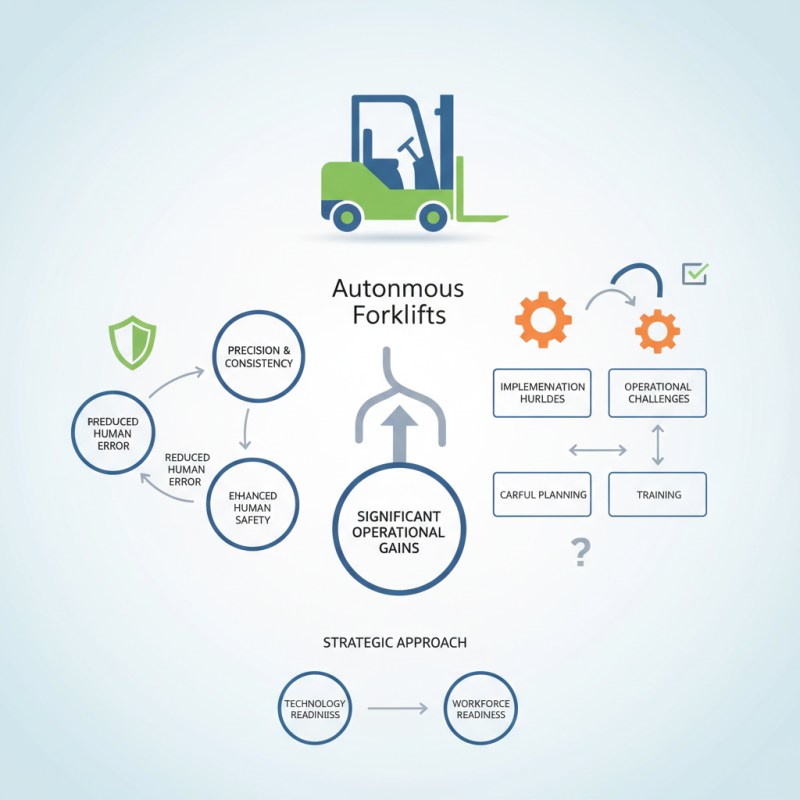
Autonomous Forklifts offer unparalleled precision and consistency. They reduce human error and enhance safety in busy environments. However, the transition to fully autonomous systems can be daunting. Integrating these machines requires careful planning and training. Despite their advantages, many industries still grapple with operational challenges. Why is that?
Understanding the benefits of Autonomous Forklifts, alongside their implementation hurdles, can provide valuable insights. The journey to full automation demands thoughtful consideration of both technology and workforce readiness. A strategic approach can lead to significant operational gains, but it is not without its uncertainties.
Benefits of Autonomous Forklifts in Warehouse Efficiency
Autonomous forklifts are transforming warehouse operations. They enhance efficiency by optimizing material movement. These vehicles operate around the clock, reducing downtime. With advanced sensors and AI, they navigate spaces adeptly. This means fewer collisions and damage to goods.
The integration of autonomous forklifts can result in significant cost savings. Companies can lower labor costs and offset initial investment costs over time. However, challenges arise in ongoing maintenance and technology updates. Workers may need training to adapt to new systems. Yet, the potential for increased productivity remains high.
Efficiency is not just a buzzword; it reflects real gains. Autonomous forklifts streamline processes and enhance order accuracy. They can cut down on human error, reducing waste and delays. Still, some managers express concerns about over-reliance on technology. It’s essential to maintain a balance between automation and human oversight.
Cost Savings Through Automation in Material Handling
In today’s fast-paced logistics world, automation is key. Autonomous forklifts offer a powerful solution for warehouse operations. They can reduce costs significantly. By minimizing labor expenses, companies can allocate resources to other vital areas.
One major advantage of these machines is their ability to optimize routes. They utilize advanced sensors to navigate efficiently. This reduces fuel consumption and wear on the equipment. Cost savings evident in this aspect can be substantial over time. However, integrating this technology isn’t always smooth. Employees may resist changes. It’s important to address their concerns upfront.
Tips for smooth implementation involve training staff effectively. Teach them about the benefits of automation. Encourage a culture of adaptability. Additionally, regularly assess the performance of autonomous forklifts. This will help identify areas for improvement. Remember, technology is only as good as the people using it. Reflection on the workflow process is crucial. Engage everyone in the transition; it can lead to greater overall efficiency.
Why Choose Autonomous Forklifts for Your Warehouse Operations?
| Feature | Traditional Forklifts | Autonomous Forklifts | Cost Savings (%) |
| Labor Costs | $20/hour | $0 (no operator needed) | 100% |
| Operational Efficiency | 60% utilization | 90% utilization | 50% |
| Maintenance Costs | $500/month | $200/month | 60% |
| Accident Rate | 5 accidents/year | 1 accident/year | 80% |
| Return on Investment (ROI) Timeframe | 3-5 years | 1-2 years | 40% |
Impact of Autonomous Forklifts on Labor Management
Autonomous forklifts are revolutionizing warehouse operations. They enhance labor management by reducing the need for manual handling. With automated systems, tasks become faster, allowing teams to focus on higher-value activities. Employees can reallocate their time to strategic initiatives rather than routine lifting.
Tips: Invest in training for your team. Ensure they understand how to work alongside these machines. Effective training will help integrate technology seamlessly.
Some workers might feel threatened by automation. It’s important to address these concerns effectively. Open dialogue can ease fears. Encouraging collaboration between humans and machines is vital for a positive work environment.
Tips: Highlight the new roles created by automation. Emphasizing the importance of skill development can foster a better workplace atmosphere.
Autonomous forklifts can provide significant efficiency but require careful management. Analyzing productivity metrics can unveil areas needing improvement. Regular assessments will ensure that both the technology and the workforce are optimized for success.
Safety Enhancements Offered by Autonomous Forklifts
Autonomous forklifts are redefining safety standards in warehouse operations. These machines are designed to reduce human error, which is a leading cause of workplace accidents. Equipped with advanced sensors and cameras, they can navigate aisles, detect obstacles, and avoid collisions. This technology not only protects workers but also prevents damage to goods.
One significant safety enhancement is the ability to operate without fatigue. Human operators can become tired, leading to lapses in attention. Autonomous forklifts maintain consistent performance throughout their shifts. This consistency is crucial in busy environments where every second counts. Additionally, these forklifts can communicate with each other, creating a safer work environment by coordinating movements.
However, relying entirely on technology raises questions. How often do these systems undergo maintenance? Are the safety protocols up-to-date? These considerations are vital for ensuring ongoing safety and reliability in the workplace. Organizations must remain aware of the limitations and continually assess the performance of autonomous systems. Responsible integration of this technology enhances overall warehouse safety.
Future Trends in Autonomous Forklift Technology for Warehousing
Autonomous forklifts are transforming warehousing with advanced technology. Recent data shows that the global autonomous forklift market is expected to reach $12 billion by 2026, expanding at a CAGR of 16% from 2021. This growth highlights the increasing reliance on automation in logistics. The technology enhances efficiency, reduces labor costs, and minimizes human error, making operations smoother.
One trend shaping the future is the integration of AI and machine learning. These innovations allow forklifts to learn from their surroundings. As a result, they become more efficient over time. Moreover, sensor technology is improving, enabling better obstacle detection. Facilities utilizing these technologies report up to 30% increase in productivity.
Tip: Start slowly. Implement autonomous systems gradually. Conduct trials to assess effectiveness before full-scale integration.
Another notable development is the rise of collaborative robots, or cobots. These machines work alongside human operators. They handle repetitive tasks, which reduces physical strain on employees. According to the Logistics Management report, over 40% of warehouses are already piloting such robots.
Tip: Focus on workforce training. Up-skilling your staff ensures they can work effectively alongside autonomous systems.
As companies embrace these advancements, real-world challenges remain. Security issues and maintenance costs need careful consideration. Ethical concerns also arise around workforce displacement. Addressing these points is crucial for a balanced approach to automation.