How to Choose the Best Refill Packing Machine for Your Needs
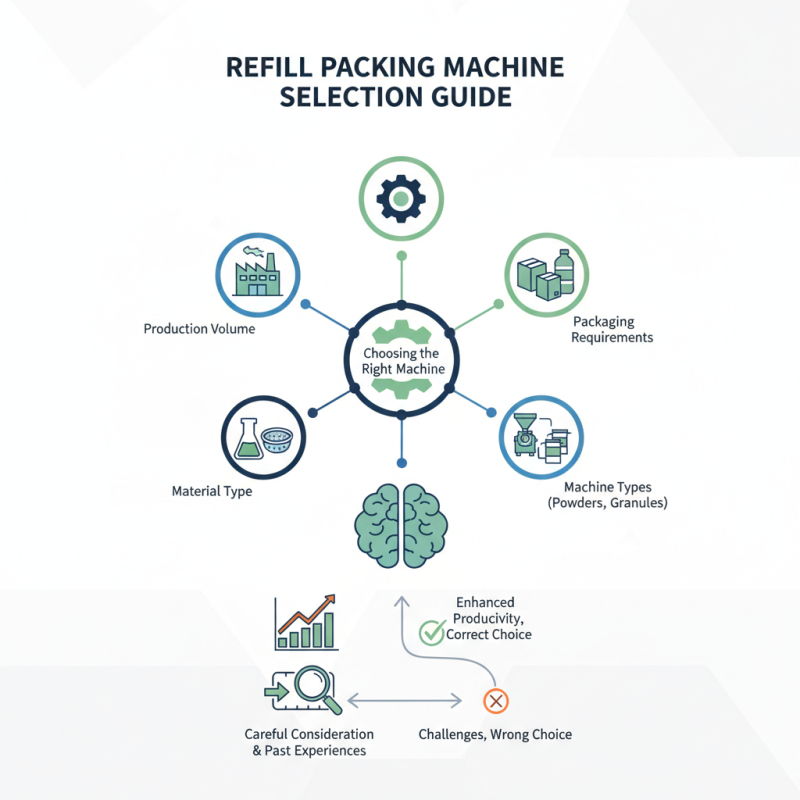
Choosing the right Refill Packing Machine is essential for any business. It can significantly impact efficiency and product quality. Many factors influence this decision, including production volume, material type, and packaging requirements.
Understanding the different types of refill packing machines is crucial. Some are designed for liquids, while others suit powders or granules. Knowing your specific needs will help narrow down your options.
The selection process requires careful consideration. Investing in the right machine can enhance productivity but may also lead to challenges if the wrong choice is made. Reflecting on past experiences can guide your decision and ensure you make a reliable choice for your business.
Understanding Your Product Specifications and Requirements
Choosing the right refill packing machine begins with understanding the specific needs of your product. Different products have varying requirements, including viscosity, particle size, and packaging material. For example, a viscous liquid might need a machine with precise flow control to avoid spills. The packing speed must also align with production goals. Research shows that companies accurately matching machines to product specifications can boost efficiency by up to 40%.
Understanding the characteristics of your product helps in machine selection. The forecast for the global packaging machinery market expects growth at a CAGR of 7.2%, reaching $45 billion by 2025. Features like automated controls and adjustable settings can lead to better packing accuracy. However, not every machine excels in all areas. Some may be more suitable for high-volume production, while others shine in small-batch settings. Assessing these factors critically can help avoid costly mistakes.
Efficiency also depends on machine reliability. Breakdowns can halt production, leading to waste and financial loss. A report from the Packaging Machinery Manufacturers Institute highlights that maintenance costs can account for up to 25% of total operational costs. Investing time in evaluating product specifications, along with potential machine failings, is essential for informed decision-making.
Choosing the Right Refill Packing Machine: Product Specifications
Evaluating Different Types of Refill Packing Machines
When evaluating different types of refill packing machines, consider several key features. Start by assessing the machine's capacity. Some machines handle small batches, while others are designed for large-scale production. Understanding your volume needs is crucial. Machines differ greatly in terms of speed and efficiency. Look for models that offer variable speed settings to match your production rhythm.
Next, examine the types of materials these machines can handle. Some are versatile and can pack a variety of products, while others may be limited to specific materials or sizes. This could impact your business if you plan to diversify your offerings in the future. User-friendliness is also a critical factor. Machines that require extensive training can slow down operations. Ensure that the controls are intuitive and that maintenance is straightforward.
It's worth noting that not all machines are perfect. Some might struggle with consistency or have issues with packing integrity. Regular maintenance is necessary to keep them in optimal condition. Pay attention to user reviews or case studies. They can provide insights into potential pitfalls. Ultimately, your choice will depend on your specific needs and how well the machine aligns with them.
How to Choose the Best Refill Packing Machine for Your Needs - Evaluating Different Types of Refill Packing Machines
| Machine Type | Speed (units/hour) | Fill Volume Range (ml) | Power Supply (kW) | Key Features |
| Vertical Form Fill Seal | 30-100 | 50-1000 | 2.5 | Compact Design, High Efficiency |
| Semi-Automatic Piston Filler | 15-30 | 100-5000 | 1.5 | Adjustable Fill Volume, Easy to Operate |
| Fully Automatic Auger Filler | 80-250 | 20-2000 | 4.0 | High Precision, Integrated Control Systems |
| Cup Filler Machine | 20-60 | 50-1000 | 2.0 | Versatile, Quick Changeover |
Assessing Production Capacity and Speed Needs
When selecting a refill packing machine, production capacity and speed are critical factors. Industry reports indicate that machines must align with your output needs. For instance, if you require 1,000 units per hour, the machine should accommodate, ideally with some buffer. This allows for unforeseen downtimes or maintenance.
Speed also correlates with packaging material. Certain materials may slow down processes. A 2022 study found that over 37% of manufacturers face slow speeds due to inadequate machine specs. Therefore, evaluating the materials you use is essential. Not all machines handle all materials efficiently. Research may reveal that some packages require more time, increasing overall costs.
Consider future growth when assessing capacity. A machine that meets today’s demands might fall short later. A flexible design can adapt to higher outputs. The manufacturing industry often overlooks this aspect, leading to increased operational bottlenecks. Analyzing historical production data can provide insights. However, understanding market trends also plays a role in informed decision-making.
Considering Budget Constraints and Cost of Ownership
When selecting a refill packing machine, budget constraints play a crucial role. Recent industry reports indicate that the average cost of these machines can range from $20,000 to $100,000, depending on the complexity and automation levels. Understanding these figures is essential for small to medium businesses. For them, the initial investment can be daunting, but the cost of ownership often extends beyond the purchase price.
Maintenance costs should be considered carefully. According to a study by Packaging World, companies can spend up to 10% of the purchase price annually on maintenance. This can add up significantly over time. Reliability is a key factor. A machine that frequently breaks down can lead to halted production and lost revenue. Investing in a machine with a lower operational cost may yield better long-term financial health.
Training costs also contribute to the overarching budget. Employees require training to operate new machines effectively. This investment is often overlooked, yet it significantly impacts workflow and efficiency. Companies should conduct a thorough analysis of their operational needs versus financial limits. Such reflection can reveal crucial insights into whether short-term savings are worth the potential long-term setbacks.
Researching and Comparing Manufacturer Reputation and Support Services
When selecting a refill packing machine, it is important to consider the manufacturer's reputation. A strong reputation often reflects years of reliable service and quality products. Look for companies with positive reviews from previous customers. This can provide insight into their customer service and product reliability.
Support services are another crucial factor. Does the manufacturer offer comprehensive after-sales support? Access to technical assistance can greatly reduce downtime. Additionally, check if they provide training for your staff. A company that invests in customer training shows commitment.
Be cautious of manufacturers with poor feedback or unclear support policies. This can lead to frustration and additional costs. Clear communication from the manufacturer is vital. If they cannot answer your questions promptly, consider looking elsewhere. Making an informed decision can lead to better productivity and efficiency in your operations.