Top 10 Standard Conveyor Types for Global Buyers

A Standard Conveyor may look simple: a moving belt, a row of rollers, or a chain carrying products between workstations. Yet choosing the wrong type can create noisy transfers, product damage, and avoidable maintenance. The right choice depends on the material, route, load, speed, environment, and available floor space. Small details matter. A damp package, a sharp turn, or a dusty loading point can change what works in daily operation.

Conveyor-industry specialist Todd Swinderman has written extensively about conveyor performance and safety. As an editorial paraphrase of that practical focus—not a verbatim quotation: “Choose for the material and operating conditions, not the brochure.” This guide compares ten common options, including belt, roller, chain, screw, slat, and overhead conveyors. It highlights where each type fits, what buyers should verify, and where trade-offs deserve a closer look. A roller conveyor may suit firm cartons but fail to control loose items. A belt may handle varied products, yet demand careful attention to tracking and cleaning. There is no universal winner. And specifications alone can mislead. The examples are a starting point, not a substitute for checking actual loads, transfer points, maintenance access, and future capacity with a qualified supplier.

Top 10 Standard Conveyor Types for Global Buyers

How Standard Conveyor Systems Move Materials Across Industries

Top 10 Standard Conveyor Types for Global Buyers
How Standard Conveyor Systems Move Materials Across Industries

Standard conveyor systems move goods along predictable routes, linking receiving, processing, packing, and shipping areas. Belt conveyors carry cartons over long, steady runs. Roller conveyors let cases roll between workstations, while chain conveyors handle heavier loads. Screw conveyors move powders through enclosed troughs, and vertical conveyors transfer products between floors. Each type solves a different movement problem; choosing by price alone can create bottlenecks.

In food processing, smooth belts can support frequent cleaning. In warehouses, gravity rollers may reduce motor use on short transfer lines. Mining and construction often need robust belts for bulk materials. The details matter: load weight, speed, incline, dust, washdown, and available floor space shape the design. MHI’s 2024 Annual Industry Report found that 55% of respondents planned to increase supply-chain technology and innovation investment over five years. That points to growing automation interest, but a conveyor still needs to fit the actual workflow. The first layout is rarely perfect.

Tips: Map each handoff before specifying equipment. Measure the heaviest load and peak flow, not just an average shift. Leave safe access for cleaning and maintenance. A small curve or transfer gap can disrupt an otherwise sound line.

Top 10 Standard Conveyor Types for Global Buyers

How standard conveyor systems move materials across industries

This chart shows common applications, not capacity or performance ratings. Unit loads include packages, totes, and pallets; bulk materials include powders, granules, and other loose solids. Specialized designs may handle additional material types.

Key Criteria for Comparing Conveyor Types in Global Markets

Top 10 Standard Conveyor Types for Global Buyers

Key Criteria for Comparing Conveyor Types in Global Markets

Global buyers should compare conveyor types by duty, not by catalog label. Start with peak throughput, load size, weight, route, and operating hours. A belt conveyor can move mixed cartons smoothly, while rollers suit rigid, flat-bottomed packages. Cleated belts help with inclines; overhead systems can free floor space. Also check washdown needs, noise, controls, spare-part access, and local service capacity.

MHI’s 2024 Annual Industry Report found that 55% of surveyed supply-chain professionals planned to increase technology investment. This is a broad investment signal, not proof that one conveyor fits every site. Compare energy use and maintenance requirements too; purchase price alone can mislead. Data sheets may hide seasonal peaks. A site trial with the heaviest real load can reveal transfer jams and awkward maintenance access.

Tips: Measure the actual package mix, including the odd oversized carton. Check peak-hour rates, not daily averages. Record cleaning time and jam recovery during a pilot. Small gaps matter. Test it locally.

The 10 Standard Conveyor Types and How Each One Works

Top 10 Standard Conveyor Types for Global Buyers

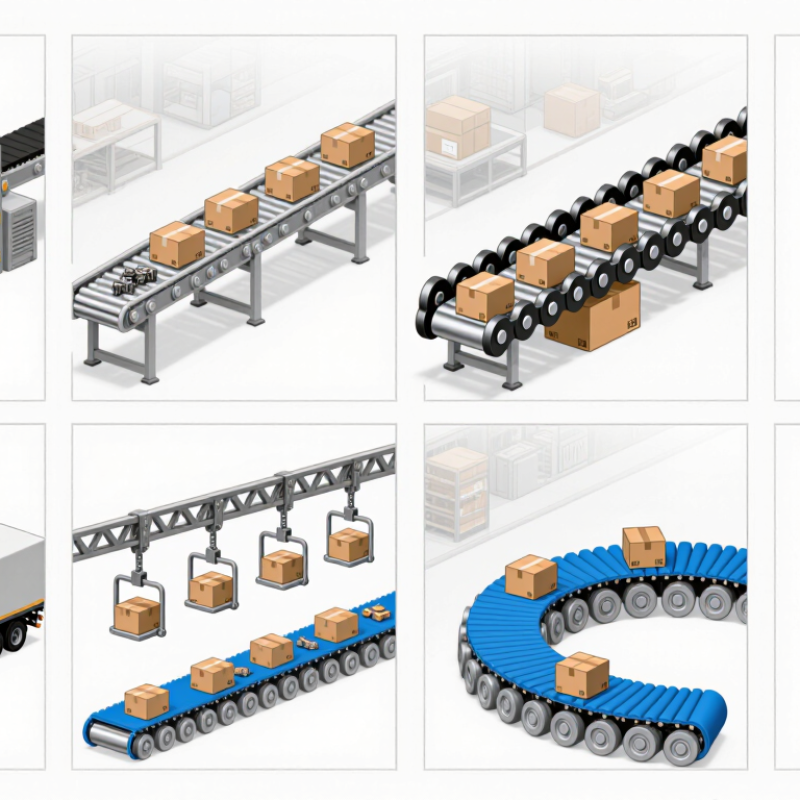
Belt conveyors carry goods on a continuous moving surface, from parcels to bulk materials.

Roller conveyors use gravity or powered rollers to move cartons along a line.

Chain conveyors pull heavy loads using linked chains; slat conveyors carry products on attached plates.

Simple, but not universal. The Conveyor Equipment Manufacturers Association’s Belt Conveyors for Bulk Materials explains how belt design and operating conditions affect bulk handling.

Screw conveyors rotate a helical blade inside a trough, pushing powders or grains forward.

Pneumatic systems move materials through pipes using airflow.

Bucket elevators lift loose materials in attached buckets.

Overhead conveyors suspend products from a track, freeing floor space.

Vibratory conveyors use controlled vibration to advance parts.

Modular-belt conveyors use linked plastic sections that can curve around equipment.

It moves gently. Not every product tolerates vibration or tight turns.

Selection depends on load, route, cleanliness, and required speed. MHI’s 2024 Annual Industry Report found that 55% of surveyed organizations planned to adopt robotics and automation within five years, making conveyor integration an important design consideration.

Yet automation does not fix a poor layout. A transfer point can spill powder, while a poorly matched roller pitch can leave small cartons unstable. The details matter. One overlooked constraint can make an efficient-looking system awkward to operate.

Matching Conveyor Designs to Materials, Workflows, and Operating Conditions

A conveyor should match the material, route, and working environment—not just the required speed. Belt conveyors suit many cartons and packaged goods, while roller systems work well when items have flat, firm bases. For loose grain or powders, screw conveyors can move material through an enclosed path. They are less suitable when fragile particles must remain intact. Small details matter.

A plant handling damp aggregate may need a belt with suitable surface grip and scrapers to limit carryback. For steep rises, cleated belts or bucket elevators can help control rollback and spillage. Chain and slat conveyors are useful for heavy loads or hot products, but their moving parts need planned inspection. Vibratory conveyors can spread or feed parts evenly. Overhead systems may free floor space, though suspended loads require careful route planning.

Operating conditions narrow the choices further. Dust, washdown, temperature changes, noise limits, and available maintenance access all affect performance. A compact layout may favor a modular system, but tight turns can create transfer points where products snag. Check load dimensions, peak throughput, and start-stop cycles using real production data. A tidy specification can still miss an awkward handoff between machines; observe that transfer during a trial if possible. Also allow room for cleaning and routine repairs.

Top 10 Standard Conveyor Types for Global Buyers — Matching Conveyor Designs to Materials, Workflows, and Operating Conditions

Conveyor Type How It Moves Material Suitable Materials or Loads Typical Workflows Operating Conditions Key Advantages Selection Considerations
Belt Conveyor A continuous belt travels over pulleys and support rollers, carrying material along a fixed route. Cartons, parcels, packaged goods, aggregates, grain, and other bulk materials, depending on belt design. Production lines, packing areas, distribution centers, and bulk-material transfer. Suitable for straight or inclined routes within the belt’s traction and load limits. Outdoor use may require weather-resistant components. Versatile, handles a wide range of load sizes, and can move materials over relatively long distances. Specify belt material, width, speed, incline, load, transfer points, and whether spillage or product contact is a concern.
Gravity Roller Conveyor Loads roll along free-turning rollers under gravity or when pushed manually. Rigid, flat-bottomed items such as cartons, totes, trays, and suitable pallets. Accumulation zones, packing stations, short transfers, and manual picking lines. Typically used on level or gently sloped routes. Requires loads with a stable base and sufficient rigidity to bridge roller gaps. Simple, does not require a drive motor, and can be configured for flexible layouts. Check item weight, base dimensions, roller spacing, slope, and the need for braking or controlled accumulation.
Powered Roller Conveyor Motor-driven rollers or drive belts move and may accumulate individual unit loads. Cartons, totes, bins, and pallets when rollers and frame are rated for the load. Sortation, order fulfillment, assembly lines, and automated transfers between work areas. Useful where controlled movement or accumulation is needed. Drive zones and controls should match the load and operating rate. Supports automated flow and can provide controlled starts, stops, and accumulation. Confirm load dimensions and weight, throughput, zone logic, controls, noise requirements, and maintenance access.
Chain Conveyor One or more driven chains carry, drag, or support loads using attachments or a suitable conveyor bed. Heavy pallets, fixtures, metal parts, and other robust loads suited to the chain and attachment design. Assembly, manufacturing, pallet handling, and heavy-duty transfer operations. Can serve demanding industrial environments; exposure to dust, moisture, heat, or chemicals must be checked against component materials. Designed for durable, positive movement of heavy or rugged loads. Assess load support, chain pitch, attachment type, lubrication, guarding, noise, and the need for regular inspection.
Slat Conveyor Linked slats form a continuous carrying surface driven by chains. Rigid products, containers, components, and items that need a more continuous support surface than rollers provide. Packaging, bottling, assembly, and transfer of products between processing steps. Can be designed for straight, curved, or inclined paths. Slat and chain materials should suit the washdown or ambient environment. Provides stable support and can accommodate defined product spacing and route layouts. Consider product contact, slat gaps, turning radius, cleaning needs, and resistance to wear or corrosion.
Screw Conveyor A rotating helical screw moves bulk material through a trough or enclosed tube. Powders, grains, granules, and other flowable bulk solids compatible with the screw and casing. Metering, conveying, mixing, or feeding materials in processing and storage systems. Often used over relatively short routes. Performance depends on material flowability, moisture, abrasiveness, and conveying orientation. Enclosed conveying can help contain dust, and the design can integrate feeding or metering functions. Check material properties, required capacity, screw speed, wear, cleanout access, and risk of material degradation.
Bucket Elevator Buckets attached to a belt or chain lift material vertically and discharge it at the head. Free-flowing bulk solids such as grain, pellets, and selected powders or granules. Vertical transfer between storage, processing, and bulk-handling equipment. Requires a suitable feed and discharge arrangement. Dust control, alignment, and access for inspection are important. Moves bulk material vertically while using a relatively compact floor footprint. Match bucket type and spacing to material behavior, capacity, lift height, abrasion, and dust-control requirements.
Vibrating Conveyor Controlled vibration advances material along a trough or deck. Bulk solids, parts, or products suited to vibration and the selected trough surface. Feeding, screening, sorting, cooling, and transferring material between process stages. Useful in process lines where vibration is acceptable. The frame and supports must be designed to manage dynamic forces. Can combine conveying with functions such as screening or product distribution. Check material fragility, noise, vibration isolation, required capacity, and any effect on nearby equipment.
Pneumatic Conveyor Airflow carries bulk material through a pipeline in dilute-phase or dense-phase systems. Compatible powders, granules, and pellets; material suitability depends on particle size, density, and fragility. Enclosed transfer between silos, hoppers, process equipment, and other locations. Can route through pipes around obstacles. System performance depends on distance, bends, air supply, and material characteristics. Enclosed routing can reduce open transfers and make complex layouts possible. Evaluate air consumption, filtration, pipe wear, product damage, dust controls, and material-specific conveying behavior.
Overhead Conveyor A suspended track carries trolleys or carriers above the floor, manually or with a powered drive. Hanging parts, garments, components, and loads that can be securely supported by carriers. Assembly, finishing, garment handling, and movement between workstations while keeping floor space clear. Route and support structure must accommodate load, turns, elevation changes, and any process-area conditions. Uses overhead space and can link multiple work areas without occupying the main floor route. Confirm building structure, carrier design, load security, clearances, maintenance access, and safe operator interaction.

Selection note: Conveyor capacity and suitability depend on the actual load or material, route geometry, duty cycle, environment, and safety requirements. Confirm these factors with a qualified system designer before specifying equipment.

What Global Buyers Should Check Before Selecting a Conveyor System

A conveyor should match the job, not just the floor plan. Before comparing types, document product dimensions, weight, surface, throughput, and the heaviest accumulation point. Measure the route, including bends, elevation changes, and space for maintenance access. Fit matters. A carton that turns easily on a roller line may snag when its base is soft or uneven.

Check operating conditions and integration needs. Will the system handle washdowns, dust, temperature changes, or frequent starts and stops? Specify guarding, emergency stops, noise limits, controls, and spare-parts availability.

The 2024 MHI Annual Industry Report found that 55% of surveyed organizations planned to increase supply-chain technology investment. That makes control-system compatibility worth checking early, not after installation. The U.S. Department of Energy’s motor-systems sourcebook estimates motor-driven systems use about 70% of U.S. industrial electricity, so compare expected energy use alongside purchase price.

Ask suppliers to state rated capacity, speed range, duty cycle, and assumptions behind performance figures. Request a layout drawing and test representative products, including awkward loads. I would verify the proposed rate against actual peak demand; average throughput can hide short bursts that cause queues. Also confirm who handles commissioning and operator training.

A detail often missed: leave room to reach a jam safely. I would recheck that clearance on the factory floor, because drawings can make tight spaces look generous.