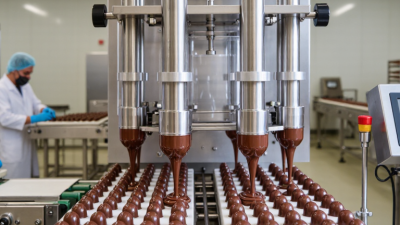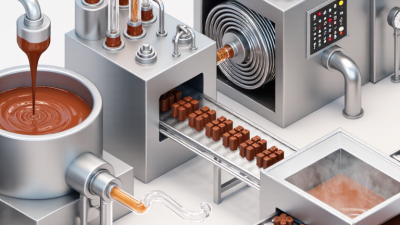
China’s chocolate equipment sector deserves careful evaluation, not a simple “lowest price wins” judgment. A reliable Chocolate depositing machine should deliver stable weights, clean release, accurate temperature control, and repeatable production across different chocolate recipes.
Grand View Research valued the global chocolate market at approximately USD 119.56 billion in 2023. Its report also forecasts continued growth through 2030, driven by premium products, seasonal confectionery, and convenient snack formats. Meanwhile, the International Cocoa Organization reported global cocoa grindings of about 4.86 million tonnes in the 2023/24 season. These figures suggest stronger demand for efficient and flexible depositing systems.
The machine is only one part of the result. Chocolate viscosity, tempering quality, mould temperature, and cooling conditions can change the final shape. Ewald Notter, a respected chocolatier and chocolate educator, is widely associated with the statement, “Chocolate is an art, not a science.” That reminder matters on a factory floor.
Precision still matters.
When comparing China’s best suppliers, buyers should inspect nozzle design, servo accuracy, hopper insulation, cleaning access, spare-part support, and documented food-contact materials. Factory trials are more persuasive than polished brochures. Ask to see real deposits, including shells, bars, pralines, and inclusions.
A cheaper machine may appear attractive. However, unstable depositing can create heavier pieces, surface defects, and avoidable waste. That assumption can fail.
This guide examines Chinese Chocolate depositing machine suppliers through engineering capability, operating experience, quality evidence, after-sales service, and customization depth. It also considers an uncomfortable point: supplier rankings can change when product volume, chocolate formula, and local service requirements change.
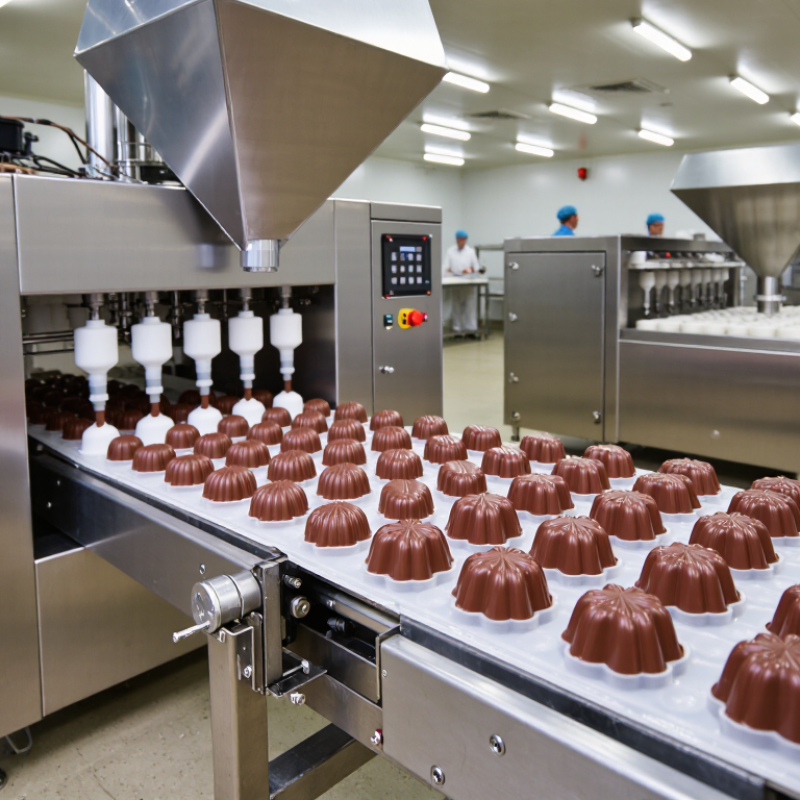
Chocolate depositing machines shape portion size, product appearance, and production speed. Servo-piston depositors handle thick chocolate, fillings, and inclusions with controlled volume. Rotary depositors suit molded pieces and repeated patterns. Continuous systems support high-throughput lines. They work quickly.
The practical target is often a 1–30 g deposit range. Piston diameter, stroke length, nozzle design, and chocolate temperature affect each shot. A well-tuned servo system can approach ±1–2% portion variation under stable conditions. That result is not automatic. A 10 g piece may drift when viscosity changes during a long shift. Operators should check weight samples, nozzle temperature, and hopper level at fixed intervals.
Grand View Research estimated the global chocolate market at approximately US$129.6 billion in 2023, showing why portion control matters at scale. PMMI industry research also identifies automation, labor efficiency, and consistent quality as major packaging investment drivers. These reports support automation, but they do not replace factory trials. In my experience, buyers often focus on maximum speed and overlook changeover losses. That is a costly blind spot. Request test data at 1 g, 10 g, and 30 g, not only the supplier’s best result. Measure average weight, standard deviation, start-up waste, and cleaning time. A machine may claim broad accuracy, yet real performance depends on formulation, ambient temperature, and operator discipline.
China Best Chocolate Depositing Machine Suppliers?
A capable chocolate depositor should deliver 20–60 deposits per minute during real production, not only during a showroom test. Speed depends on chocolate viscosity, temperature, nozzle size, and product spacing. Ask suppliers to run your recipe with your moulds. Watch the stream closely. It should remain steady, without tails, splashes, or uneven filling.
Weight control is equally important. A ±1% target can reduce giveaway and improve product consistency. However, this figure needs verification under working conditions. Request samples from the beginning, middle, and end of a production run. Weigh them with a calibrated scale. Ten pieces may reveal variation that a single sample hides. Servo-driven dosing, stable heating, and responsive sensors can support tighter control, but they cannot correct poorly tempered or inconsistent chocolate.
Experienced buyers should also inspect changeover time and cleaning access. Narrow passages may trap chocolate and delay the next batch. Check whether operators can adjust deposit volume without complicated tools. Ask for maintenance records, calibration procedures, and measured test data rather than attractive claims. One practical concern is often overlooked: maximum speed may reduce accuracy when the chocolate warms or the hopper level falls. A slower setting may produce better commercial results. Supplier testing should reflect your actual recipe, deposit weight, mould format, and shift length.
Reference comparison of chocolate depositing machine operating points based on throughput and maximum target weight deviation. A suitable machine should support 20–60 deposits per minute while maintaining weight control within ±1%.
The throughput range represents typical low, standard, and high production settings. The dashed line marks the ±1% weight-control limit used as a practical selection benchmark.
Choosing a Chinese chocolate depositing machine supplier requires more than comparing prices. Certifications provide an initial quality signal, but buyers should verify their scope and validity. Look for documented compliance with food-contact requirements, electrical safety standards, and quality management systems. Ask for recent certificates, not scanned files from several years ago. Details matter.
Factory capacity should match your production plan. A reliable supplier can explain monthly output, machining resources, assembly procedures, and testing equipment. During a factory visit, inspect stainless-steel contact parts, heated hoppers, deposit accuracy, and cleaning access. Request a live trial using your chocolate recipe. Small differences in viscosity can affect weight consistency. The machine looked impressive.
Export experience is equally important. Review shipment records, destination markets, installation methods, and spare-parts response times. Experienced suppliers usually provide English manuals, wiring diagrams, packing photographs, and remote commissioning support. They should also understand container loading and export documentation. These practical details reduce delays at the receiving site.
Still, no supplier record is flawless. Some factories outsource key components, which may weaken after-sales control. Ask who manufactures the pump, sensors, and control cabinet. Confirm warranty terms in writing. I would also request two or three customer references, although references can be carefully selected. A cautious audit is better than a polished presentation.
China’s Best Chocolate Depositing Machine Suppliers?
Automation comparisons become practical on the production floor, not in a brochure. For chocolate lines producing 30–100 kg/h, a servo-driven depositor offers precise piston movement and repeatable portion control. It also handles recipe changes with less mechanical adjustment. At 30 kg/h, oversized equipment may waste energy and cleaning time. At 100 kg/h, a small pump can create pressure swings. Capacity must match product viscosity, mould size, and shift schedule. Numbers need context.
A servo system can coordinate hopper, pump, and nozzle timing with millisecond-level control. This helps reduce tails, splashes, and uneven shell thickness. During a site test, operators should check weight variation across a full tray, not one sample. Ask for data under real chocolate temperatures, since viscosity changes quickly near the tempering range. Manual settings are still useful. Automation does not remove judgment. That point is easy to overlook.
CIP design deserves equal attention. A hygienic machine should provide smooth product-contact surfaces, drainable piping, accessible valves, and validated wash cycles. Hot water, detergent concentration, flow rate, and rinse quality should be recorded. Dead corners can retain chocolate, even when the exterior looks clean. Confirm whether the pump, depositor head, and hoses can be cleaned without excessive dismantling. Supplier documentation should include materials, maintenance intervals, test results, and operator training. I would also inspect recovery after a cleaning fault. Machines are rarely perfect. Service response matters.
| Machine Configuration | Typical Output | Servo System | Deposit Accuracy | Suitable Product Formats | Chocolate Temperature Control | CIP Design | Hygienic Construction | Best-Fit Production Scale |
|---|---|---|---|---|---|---|---|---|
| Compact Servo Depositor | 30–40 kg/h | Servo-driven piston or rotary pump; 1–2 controlled axes | Typically ±1.5–2.0% by weight, depending on recipe and nozzle size | Small bars, pralines, hollow shells, molded pieces and inclusions | Heated hopper and jacketed product path; commonly controlled around 30–34°C for dark chocolate | Manual or semi-automatic flush; removable nozzles and quick-release manifolds | Stainless-steel product-contact parts; smooth welds and sloped surfaces | Product development, seasonal production and small confectionery lines |
| Single-Color Servo Depositor | 40–60 kg/h | Servo-controlled dosing piston with programmable stroke and speed | Typically ±1.0–1.5% by weight under stable operating conditions | Chocolate bars, discs, clusters, biscuits and one-shot molded products | Independent heating zones for hopper, valve block and depositing head | Drainable product circuit with warm-water or approved cleaning-fluid circulation | 304 stainless steel is commonly used for food-contact surfaces; non-contact frame may use painted or stainless steel construction | Small to medium factories requiring repeatable portion control |
| Dual-Color Servo Depositor | 50–70 kg/h | Independent servo dosing for two chocolate streams; synchronized filling control | Typically ±1.0–1.5% by weight for each stream | Two-color tablets, layered bars, striped products and filled centers | Separate heated hoppers and temperature loops to reduce viscosity variation | Separate circuits or independent flushing paths for dark, milk and white chocolate | Food-grade seals, accessible inspection points and tool-free removal of key product-contact components | Medium-volume lines with frequent product variety changes |
| High-Speed Servo Depositor | 70–100 kg/h | Multi-axis servo control for dosing, nozzle movement and mold indexing | Typically ±0.8–1.2% by weight when molds, viscosity and temperature are consistent | High-volume bars, molded pieces, shells, filled chocolates and decorative deposits | Closed-loop temperature monitoring with separately heated hopper, piping and depositing head | Integrated automatic rinse and circulation functions; final sanitation may still require manual inspection | Fully enclosed drive area, hygienic frame geometry and minimized product-retention points | Continuous production where throughput and changeover repeatability are priorities |
| Servo Depositor with Servo Pump | 60–100 kg/h | Servo pump regulates flow independently from conveyor or mold motion | Typically ±0.8–1.5% by weight, depending on pump calibration and chocolate rheology | Thin slabs, continuous sheets, filled bars and products requiring stable flow | Precise control of viscosity through multiple heating zones and temperature sensors | Product lines designed for draining, warm-water circulation and quick disassembly | Sanitary tubing, crevice-resistant fittings and food-grade elastomers | Medium to high output applications with strict portion consistency |
| CIP-Ready Modular Depositing Line | 80–100 kg/h | Central PLC with servo dosing, conveyor synchronization and recipe storage | Typically ±0.8–1.2% by weight under validated operating conditions | Bars, pralines, hollow products and multi-format molded confectionery | Independent zones for melting, holding, transfer and depositing; recipe-based temperature settings | Automated pre-rinse, detergent circulation, intermediate rinse and drain sequence; CIP validation is site-specific | Hygienic stainless-steel construction, sloped drainable surfaces and reduced dead legs | Export-oriented factories and plants with documented sanitation procedures |
Choosing China’s best chocolate depositing machine supplier requires more than comparing quotations. Factory acceptance testing (FAT) should mirror your production floor. Ask suppliers to run your chocolate, moulds, recipe, and target temperature. Record depositing accuracy, speed, changeover time, cleaning duration, and rejection rates. Request videos, test sheets, and calibrated instrument records.
A 2024 State of Smart Manufacturing report surveyed 1,560 manufacturers. It found that 95% were investing in, or planning to invest in, smart manufacturing. That finding makes traceable FAT data increasingly important. Screenshots are not enough. Watch a live test.
Warranty terms need precise wording. Confirm coverage for pumps, valves, heaters, sensors, PLCs, and labour. Check whether warranty time starts at shipment, installation, or commissioning. A twelve-month warranty can become weak if installation takes four months. Ask about response times, spare-parts availability, remote diagnostics, and technician travel costs. PMMI’s 2024 industry outlook continues to highlight labour pressure and the need for reliable equipment support. Downtime is expensive, even when the machine price looks attractive.
I would also request two comparable customer references. Ask how quickly faults were resolved, not whether the machine “worked well.” Keep every promise in the contract. This is where some buyers become too optimistic. A polished factory tour cannot replace a failed FAT consequence plan. Even experienced purchasers sometimes overlook local electrical standards and cleaning validation. That oversight can delay commissioning for weeks.